Things to do
A tour around Nesting
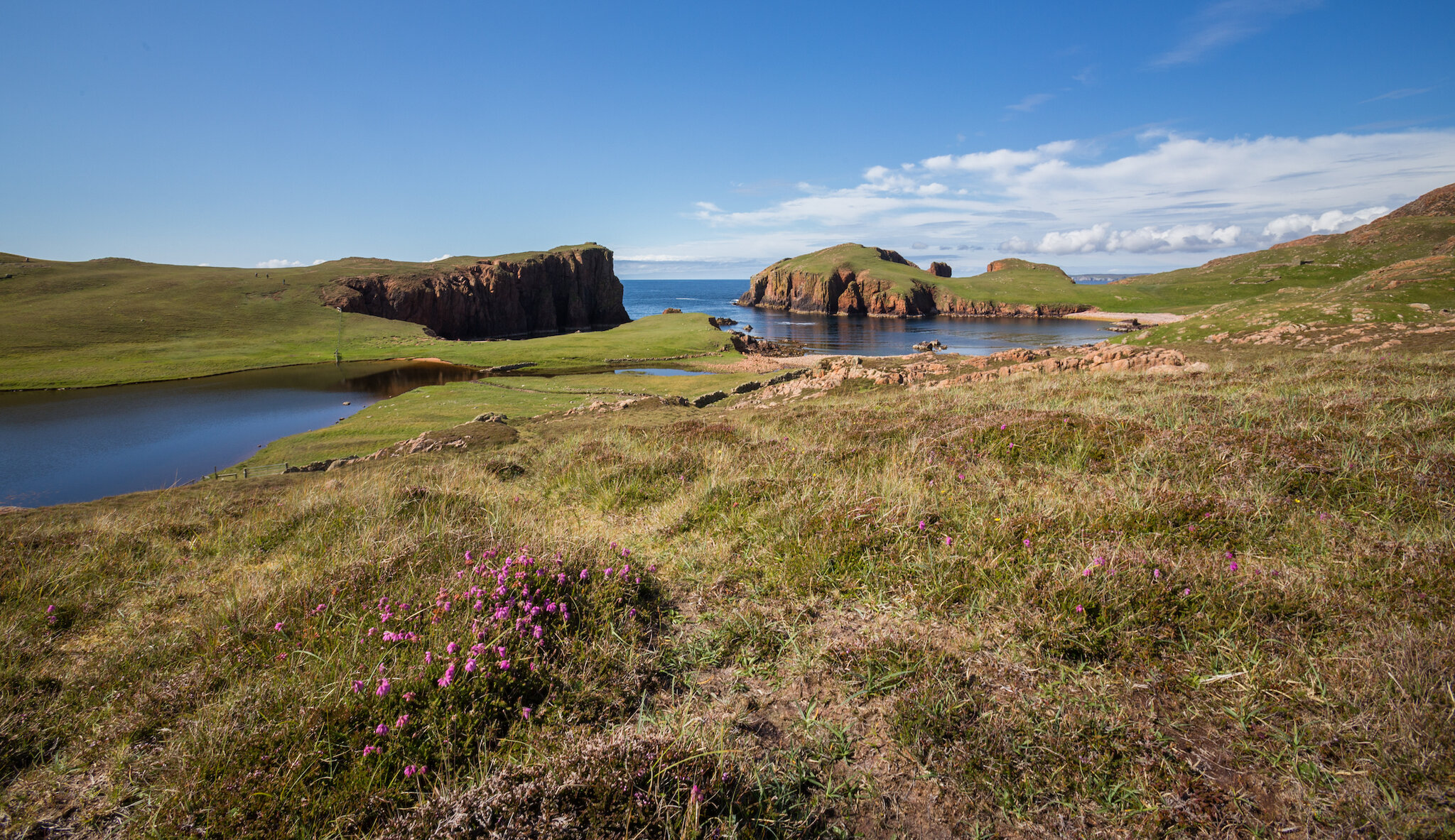
Ten miles north of Lerwick, the 'Nesting Loop' side road (B9075) winds through an intimate landscape of sheltered inlets, scattered crofts and bold headlands. There are scenic surprises around every corner.
Catfirth, once a First World War naval air station, is a favourite bird-watching spot. The Catfirth and Quoys Burns, both popular with anglers, have relics of the woodland which covered Shetland thousands of years ago: willows, rowans, and our only surviving hazel tree.
Turn right at the Nesting shop and the road leads past the Loch of Benston and its wild swans to the landlocked inlet of Vassa Voe and on to the promontories of Gletness and Eswick. Gletness is one of the most picturesque corners of Shetland and also home to a stud of Shetland ponies.
The coast road to North Nesting passes a prehistoric standing stone at Skellister and an ancient settlement and field system below the Loch of Skellister. From Brettabister a side road leads to the headland of Neap, the starting point for a fine coastal walk out to the Staney Hog and Stava Ness - where ravens and puffins nest.
Back on the B9075, the road turns inland from the war memorial at Brettabister and climbs the steep hill of the Kirk Ward. For one of the finest views of the islands, stop the car and walk up to the First World War watchtower on top of the hill on your left.
Over the hill, the hamlet of Billister is another favoured spot for sea trout. A walk along the coast to the east brings you to the 19th century granite quarry used to build the lairds' mansion at Symbister in Whalsay.
Exploring Lunnasting
North of Nesting lies Lunnasting, in which the main village is Vidlin. It lies on Vidlin Voe, a sheltered inlet with a marina for local boats at its head. There is also a ferry terminal here, used when the weather prevents use of the terminal at Laxo. Vidlin is an ancient settlement with an Iron Age broch lying under the foundations of the present Methodist kirk.
The road north from Vidlin leads to Lunna, where there is a tiny whitewashed church. Lunna Kirk dates from 1753, though there was a church on the site before then. There was also, it is said, an early monastery on Chapel Knowe, just to the north, and the whole area has more than enough lumps and bumps to set any archaeologist’s pulse racing. The church is the oldest in continuous use in Shetland and it is also one of the most beautiful.
Not far away are the lonely Loch of Stofast and the mysterious Stanes of Stofast. Once a single 2,000-tonne boulder, now broken in two by the action of repeated freezing and thawing, the Stanes were once part of a nunatak (a large angular or jagged rock protruding above the ice in a glaciated area) which collapsed following the retreat of the ice during the last glacial period. Like the nearby Lunning peninsula, this is a heavily glaciated landscape with eerily-shaped rocks associated with the trows (trolls) of Shetland folklore.
Discover Delting
The parish of Delting, which lies north-west of Lunnasting, has seen many changes since the discovery of oil off Shetland. Hundreds of new homes needed to accommodate the workforce were built in Voe, Brae, Firth and Mossbank. Today, the district is well endowed with modern facilities, including schools, community halls and an excellent swimming pool.
One of the most appealing corners of Delting is the old village of Voe, at the head of Olna Firth. The older buildings owe their origin to the 19th century merchant firm of T. M. Adie & Sons, which was involved in fishing, hosiery and tweed. One of them, the old Sail Loft by the pier, is now a Camping Böd. The company made the woollen jumpers worn by Edmund Hillary when he and Tenzing Norgay tackled the first ascent of Everest in 1953.
Five miles north of Voe, Brae is the largest village in Delting. To the west, across the water, lies Busta House. Now a hotel, the oldest part of the building dates back to 1588. Beyond Busta is the ruggedly beautiful island of Muckle Roe, linked to the mainland by a new bridge. Along its coast, contraband from Faroe was once landed in the Hams (or havens) of Roe. There’s plenty of evidence of former settlement among spectacular red granite cliffs at the north end of the island. This is a favourite destination for walkers.