By Dave HigginsMay 25th 2026

Wildlife photographer Dave Higgins has lived on islands and in unspoiled regions around the globe, but had never visited Shetland. He journeyed to the archipelago in spring to experience the birdlife at its most energetic. Here, we share a diary of his adventures,

Hermaness National Nature Reserve is named after Herman the Giant who fought Saxa, another giant, for the love of a mermaid. The skerries, islets and stacks all around are the weapons thrown in the skirmish. The unnamed mermaid swam to the North Pole, offering to marry whichever giant followed her. Both drowned trying.

Along the western flank, cragged cliffs stretch away like Middle Earth landscapes. A thousand fulmar ride the winds; silver surfers flowing through gusts with mesmerising grace. Below, the sea crashes into rocks where gannetries are set for the breeding season.

Muckle Flugga: edge of the world

It’s a slow walk along the edge of the world towards Muckle Flugga. The lighthouse has stood there since 1854. Beyond is Out Stack, the most northerly point of the UK. Then it's all sea till you summit the earth and reach Siberia.

From the top of Hermaness Hill a long sweep of boardwalk beckons away from the edge of the country, over blanket bog, sphagnum-rich and soddened. Thousand-year organic matter accumulated beneath us, the history of the land trapped as pollen, blackened by tannins, waiting to be read.

As we walk snipe zigzag. Skylark hover music above us. Wheatear flit between hummocks. A fulmar sweeps across, travelling between the borders of the earth.

As the day falters, the sky expands. Strips of ochre, auburn, deep greys and twilight blues band the air, each bleeding into the other. The colours stretch to the last light that blisters across Saxa Vord. The radar station turns dazzling white and holds us hypnotic-still. Soon the dusk turns intense blue and drifts into night, the colours deepen and the first star sparkles.

The next day we take an early walk. Linnets gather and ringed plover cluster. A small flock of starlings perform the hint of a murmuration. We discover the first lamb of the season, still yellow from amniotic fluid. This is mid-April, highlighting the difference in climates. I saw lambs in Wiltshire back in mid-February.

Otter watching in Yell

We head south to Yell where we meet James Rogerson. I’ve followed his photography for many years. He has a way of pulling art out of wildlife; his images are always distinct, always brilliant. Today he guides us along the coast, as we search for otter. Yell is renowned for sightings, but without guidance, visitors can easily disturb them.

We crouch along the coast a few metres back from the bank. To our right, half-concealed among kelp and rocks, a single otter is feeding on a lumpsucker. It tears and chews, ripping out bite-sized chunks. We creep closer, always downwind, always crouched. Slow and deliberate. The otter keeps tearing lumps; pink flesh grasps the shifting light.

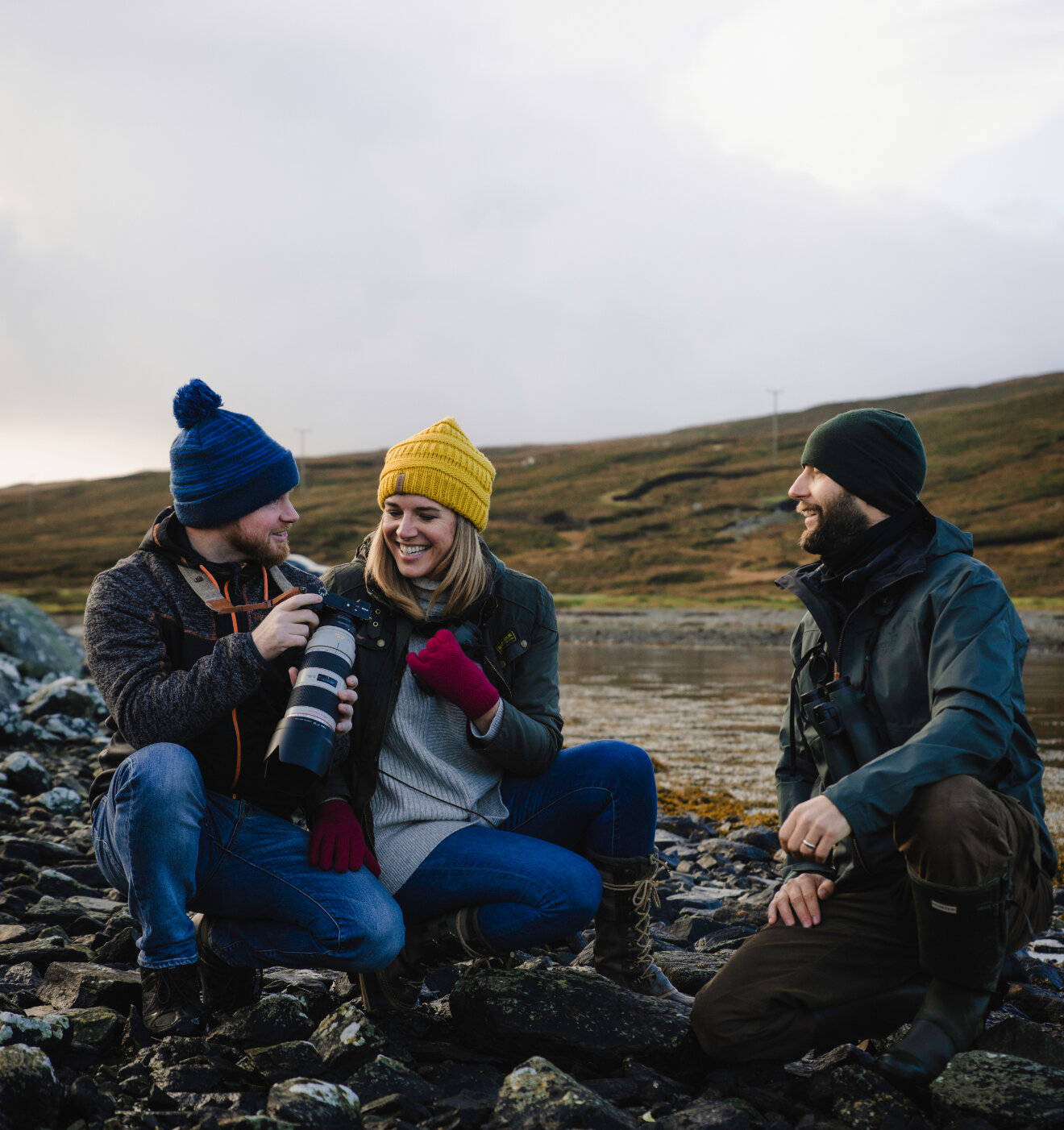
At our backs, water seeps from the peat like oozing wounds. We rest against it for cover and watch the otter for over forty minutes. To be so close to a wild animal, and completely inconsequential to it, is a wonderful thing. We take photo after photo, and in between, we watch in silence. James finds seven further otters. One family hide among the rocks. The mother brings back fish and crabs and finally an octopus with trailing arms billowing lifeless from her jaws.

Wildlife inspiring creativity

It’s time to leave. The ferry performs a high-speed turn and glides into position. We head south to Mainland, through Yell Sound, missing a sighting of killer whales by an hour.

All through the journey, we visit creative people on the Shetland Craft Trail.

Cheryl Jamieson, the owner of Glansin Glass in Unst, describes how inspiration is generated from the moors, the cliffs, seascapes and wildlife.

She recounts a memory of a rare day when the wind lapsed. Ethereal sea fogs rolled in to Easting Beach creating ghostly scenes of sand and sea.

She vividly tells how such moments hang in your memory, creating dynamic worlds of inspiration. Becky (The Silly Sheep Fibre Company), Cecil (Paparwark Furniture), Katie (Nielanell Knitwear) and Sophie (Shetland Jewellery) confirm Cheryl’s observations and discuss the inspiration found in the long threads of history.

At the Silly Sheep Fibre Company ewes use our legs as rubbing posts. Later, we visit Easting Beach for ourselves and stand in the ruins of a Viking longhouse.

Experiences along the Shetland Craft Trail. Dave Higgins

Seething seas at Sumburgh Head

On the trip south, we meet Sue White by a lonely moor. She describes peat restoration, how reprofiling of hags and lines from old peat cuts, as well as re-establishing vegetation, can spark life into peatlands. She explains that sphagnum and hydrology kickstart peat accumulation. On Shetland, the tonnage of carbon that can be sucked from the air is phenomenal.

Our north-to-south journey ends at the RSPB Sumburgh Head Nature Reserve. In the distance, the near myth of the ornithology world, Fair Isle, blots the horizon. At the base of the cliff huge waves crash in like cold-blue lava. It boils and spews. A pair of kittiwake perch above the seething broth with indifference.

A shag plucks grass from the steep slopes and flies to its nest on the opposite cliff. Guillemots scatter along the rocks. I meet the RSPB area manager, Helen Moncrieff, and her three-legged greyhound. For a while we share our love of seabirds, both lost in the majesty.

We stay till sunset. A deep sinking orange draped with stripes of cloud. A Shetland wren sings. The depth of the symphony suggests defiance.

We fitted an island odyssey into the week. North to south, east to west. From fantastic creatives that make up the Shetland Craft Trail to an exceptional guide who found an otter for us. There were Viking longhouses and seabirds, and my favourite of all, the fulmar, journeyed all the way with us.

The Shetland Islands hold a unique culture with deep roots threading into centuries of history.

The islands are wild and rich, and, like many island communities, the people are among the best. The Shetland Islands were always an ambition, but the distance was daunting. Two 24-hour trips bracket our week here, given time constraints, it always felt too much. But now we’ve had a taste, I know we’ll be back.

Vit munum snúa aptr.
(We will turn back, in Old Norse).

Plan a wild Shetland adventure

Shetland's ruggedly beautiful natural environment and geographic location, mean the islands are home to a unique and diverse range of wildlife.

This includes resident and migratory birdlife, sea mammals from orcas to the otters, wild flowers and plants found nowhere else.

All surrounded by spectacular landscapes, ancient geology, and some of Britain's most beautiful beaches.

Start planning your wild adventure today.

Experience wild Shetlandarrow-right