• Home
  • Blog
  • Shetland - science and stem careers
By Genevieve WhiteNovember 23rd 2026

With excellent schools serving communities around the islands, further and higher education opportunities, and innovative industries with huge potential to grow, Shetland is an exciting place to pursue scientific, mathematical and engineering studies and careers.

What inspires a young person to become a scientist? In Shetland, it might be a pod of orcas off the coast, an otter crossing the road on the way to school, or the tides rushing through a nearby voe. For many pupils, the inspiration is right there, just outside the classroom window.

Claire Reid is principal teacher of science at the Anderson High School. She has taught for 27 years, 25 of them in Shetland.

"I think Shetland develops some fantastic scientists because of where we live," she says.

"Whether it's orcas, an otter over at the Tesco roundabout, or the fantastic birds we have here, the nature side of Shetland really lends itself to science.

"Then there's the oil terminal, all the renewables that are going on, and the health sector. Science is here, there and everywhere, and that's where the passion starts."

"We're very lucky that kids can sit in a classroom here, look out of the window and see science all around them."

From the classroom to careers

That view isn’t just inspiring: it also happens to be pretty useful.

"Every teacher is constantly trying to link learning in the classroom with the world of work," Claire explains. "Whether it's the new spaceport, the health sector or the energy sector, the schools in Shetland link up fantastically with what's going on around them."

"There are so many parents and industries in Shetland that are passionate about where we live and how we live here. That passion comes into the classroom."

It's a message she's keen to get across, especially to older pupils. "Sometimes, as students get older, they think everything's on the mainland. But actually, there are fabulous STEM opportunities here."

The enthusiasm shows in the numbers. "When I go to meetings down south and say we've got 380 senior pupils at the Anderson High studying biology, chemistry and physics, they're all really shocked," Claire says. "We have about a hundred Higher Human Biologists alone."

Whether it's orcas, an otter over at the Tesco roundabout, or the fantastic birds we have here, the nature side of Shetland really lends itself to science. Then there's the oil terminal, all the renewables that are going on, and the health sector. Science is here, there and everywhere, and that's where the passion starts

Bringing inspiration to Shetland

There is one thing island pupils miss out on, which Claire is upfront about. “Their friends on the mainland can nip to the science centre, Dynamic Earth or Edinburgh Zoo,” she says. “Shetland bairns can’t always get off 'the rock' to experience those things.”

That’s where the Shetland Science Fair comes in. Each year, pupils from schools across the islands spend a day exploring science with visiting experts from organisations such as Dynamic Earth, alongside local partners like UHI Shetland.

The fair is organised and funded by the islands’ longest-established renewable energy company, and it works on a deliberately simple model. “The only thing we ask of the schools is that they turn up,” says David Thomson, Shetland Aerogenerators’ Chief Executive. The company takes care of everything else, from buses to planning, so that “the kids in Shetland don’t miss out”.

It’s a very Shetland way of getting things done: a local business, schools and parents joining the dots so island pupils get the same chances as anyone else.

Each fair has its own theme and plenty of hands-on activity, from planetarium shows to engineering challenges and real specimens to examine.

“At each workshop, pupils are completely absorbed, experiencing learning in a different setting,” Claire says. Senior pupils help run the day too, leading younger groups and gaining experience they can mention on college or job applications.

For Claire, the fair is about opening doors. “It helps pupils link classroom learning with the wider world of work, and opens their eyes to different types of STEM careers,” she says.

“They get to see different faces from all these STEM companies, people who are really passionate about their roles, rather than just the teacher talking about it.”

Next steps after school

When school finishes, the science doesn’t have to move south. “There are lots of different routes into STEM at UHI Shetland,” says Selina-May Miller, Marketing, Communications & Student Engagement Officer at UHI Shetland.

“One of the things we’re keen to highlight is that you don’t necessarily have to follow a traditional route into further or higher education.”

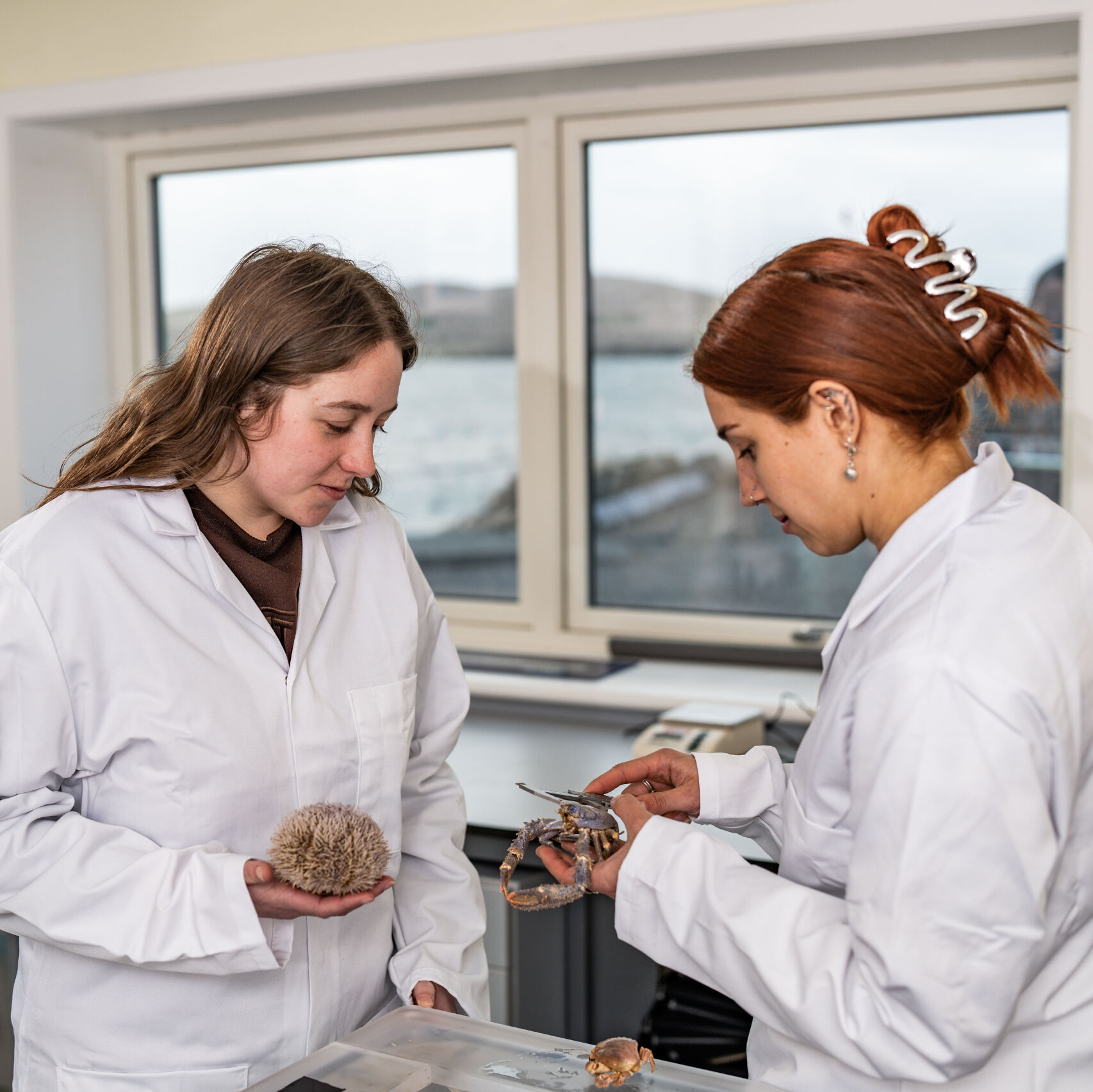
Pupils can make a start while still at school, through Skills for Work and Academy programmes in engineering, aquaculture and marine biology. After that, there are courses in marine biology, environmental science, aquaculture, engineering, marine engineering, computing and maritime studies.

The CertHE in Introduction to Marine Biology, Environmental Science and Sustainability offers an accessible way in, full-time or part-time. For anyone returning to study or changing career, flexible options and apprenticeships mean you can join at different stages.

At UHI Shetland, the view out of the window becomes part of the course. “We’re surrounded by the industries, landscapes and marine environments that students are learning about,” Selina-May says. Students carry out ecological surveys, fieldwork and sampling. UHI Shetland’s Marine Spatial Planning team works on seabed habitats, seagrass restoration and marine mapping.

“For us, it’s about showing young people that STEM isn’t just something you study in a classroom,” she says. “It’s something happening all around them, and there are opportunities to be part of it here in Shetland.”

For us, it’s about showing young people that STEM isn’t just something you study in a classroom. It’s something happening all around them, and there are opportunities to be part of it here in Shetland.

One of the joys of teaching in a small place, Claire says, is watching where her pupils end up.

"We've got doctors who've kept in touch, and bioengineers who did biology and physics and are now designing heart valves. The physics crew are engineers all over the world. Somebody got in touch recently from a yacht in South America, saying the science experiments from their old physics classes were actually happening on the boat."

Closer to home, the connections are just as strong.

"You might go to the health centre and the person taking your blood is an ex-pupil, or taking pupils on an NHS Skills bus and the experts doing the talks are ex-pupils," Claire says. "It is an absolute privilege to see how pupils who were once in your class use the skills they built in the classroom in the jobs they're doing now."

And the view from the classroom window? Still one of the best in Scotland.

Study for a STEM career in Shetland

For anyone keen to learn the skills needed for rewarding careers in science, technology, engineering and maths, Shetland has many opportunities.

From school classrooms, to UHI laboratories or on-the-job learning and apprenticeships, there are many routes to working in STEM industries.

Why study in Shetland?

Discover more and plan your next step towards an interesting career here.